
Key Takeaways
- Automated brazing can help manufacturers reduce process variation caused by differences in manual heat control, torch movement, timing, and filler application.
- Auto Brazing Systems designs equipment for aluminum-to-aluminum brazing, copper applications, condenser coils, evaporator coils, and custom production requirements.
- Its systems are intended for manufacturers that need more repeatable production sequences, improved visibility into throughput, and reduced dependence on individual operators’ techniques.
- Auto Brazing Systems reports more than 15 years of industry experience and system capabilities exceeding 4 brazed coils per minute in certain applications.
- Manufacturers should validate cycle time, labor savings, quality, integration, and maintenance expectations against their own parts and operating conditions before investing.
Why Inconsistent Brazing Creates Production Problems
Manual brazing remains valuable for repair work, prototypes, low-volume runs, and complex assemblies. However, high-volume production can become difficult when results depend heavily on each operator’s torch position, heat timing, filler placement, and ability to recognize changing conditions at the joint. Manufacturers searching for automatic copper brazing equipment often aim to make production results less dependent on individual variables.
Inconsistent heat input or filler distribution can contribute to weak joints, leaks, rework, additional inspection, and production slowdowns. These issues can be particularly significant for coil and heat-exchanger manufacturing, where many similar joints must be made repeatedly. Standardizing manual conditions through controlled automation can support more uniform production.
How Auto Brazing Systems Respond to Automated Brazing Needs
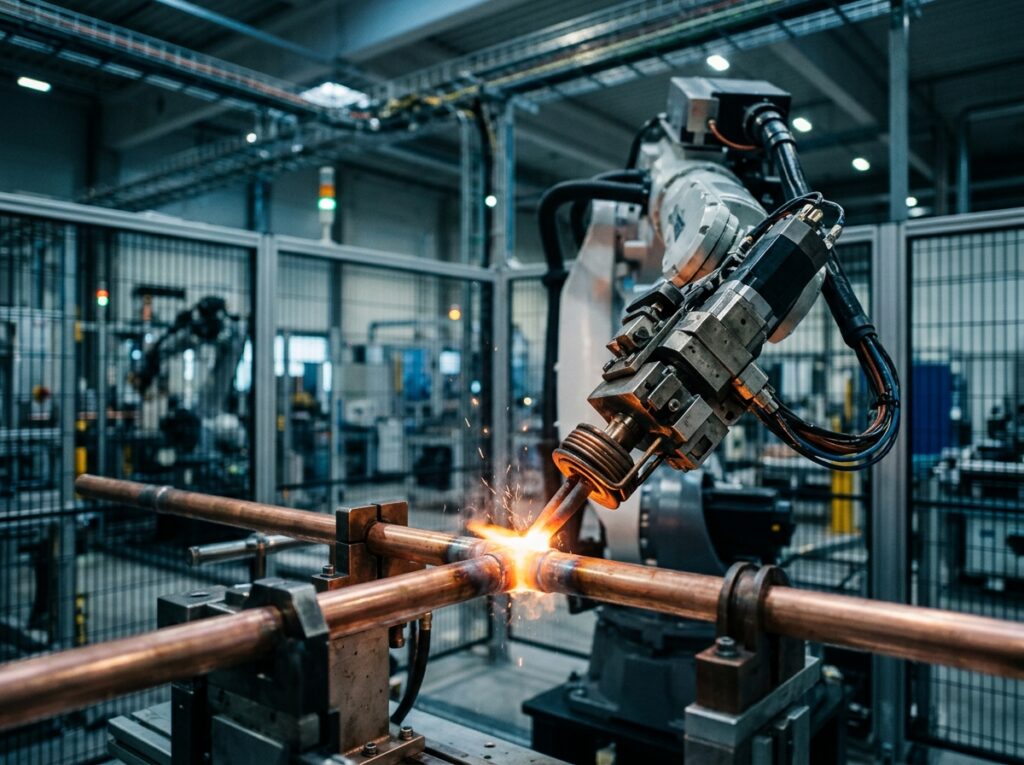
Auto Brazing Systems designs and fabricates automatic brazing equipment for manufacturers that want greater control over their joining process. The company focuses on systems that automate key stages of production, including part handling, heating, filler delivery, and repeatable process sequencing. Rather than treating every brazing application as identical, the equipment can be configured to the customer’s material, part geometry, production rate, and line-integration needs.
The company’s core expertise includes automatic aluminum-to-aluminum brazing, as well as copper brazing solutions and equipment for condenser and evaporator coils. This makes its approach relevant to manufacturers in HVAC, refrigeration, automotive, and other industries that rely on repeatable heat-transfer assemblies.
What Makes Automated Brazing Relevant to High-Volume Manufacturing?
A production line needs more than a machine that can create a joint. It needs a process that can repeatedly deliver acceptable results while fitting into upstream and downstream operations. Automated brazing can bring structure to variables that are difficult to control manually, including dwell time, torch movement, part position, heating sequence, and filler delivery.
Auto Brazing Systems reports that it has more than 15 years of industry experience and that certain systems can produce more than four brazed coils per minute. Those are company-reported capabilities, not universal production guarantees. Actual output depends on the coil design, material, joint count, loading method, required inspection, maintenance intervals, and any integration with conveyors or robotics.
Operational Benefits Manufacturers May Seek
- More predictable cycle times: Programmed sequences can reduce variation between shifts and operators.
- Greater joint consistency: Controlled heat and filler application can support more repeatable results when the parts and process are properly validated.
- Lower labor dependence: Automation can reduce the number of manual brazing tasks required for repetitive work.
- Line integration: In-line equipment can be engineered to integrate with conveyors, controls, material-handling, and robotic systems.
- Custom process fit: Purpose-built fixtures and controls can accommodate specific part geometries and production requirements.
How Automated Equipment Improves Process Consistency
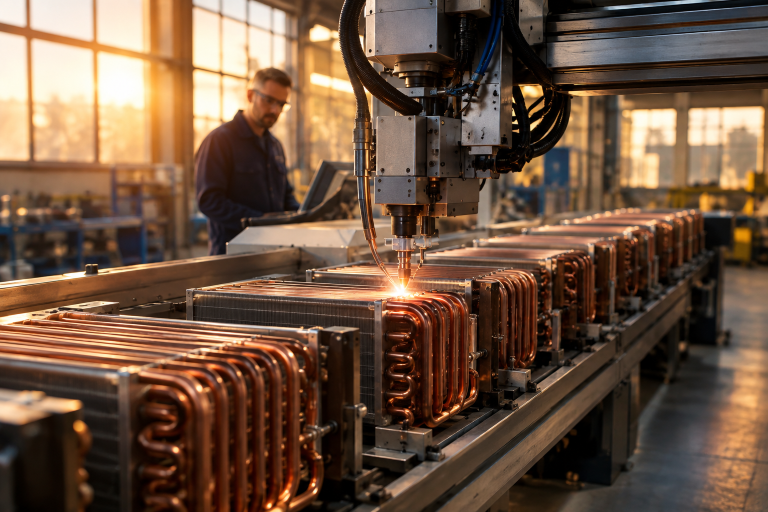
Quality brazing depends on more than simply reaching a high temperature. Joint fit-up, surface condition, filler selection, part alignment, heat distribution, timing, and cooling behavior all matter. Automation helps by executing an established sequence in a repeatable way, but it does not eliminate the need for sound joint design or process engineering.
Automated equipment still requires qualified people. Operators may load materials, monitor alarms, confirm process settings, and perform routine checks. Maintenance personnel must service mechanical, electrical, gas, and control components. Quality teams must continue to inspect products in accordance with the manufacturer’s specifications and applicable standards.
Applications Supported by Auto Brazing Systems
Aluminum-to-Aluminum Brazing
Auto Brazing Systems identifies aluminum-to-aluminum brazing as a central area of specialization. This capability is relevant to evaporator and condenser coil production, where a large number of joints must be produced consistently. Aluminum applications may require careful process control because the acceptable operating window varies with alloy choice, filler metal, wall thickness, joint design, and heat distribution.
Copper Brazing
Copper brazing systems can support manufacturers working with copper coils and related assemblies. A well-defined copper brazing process must account for component fit-up, heating method, filler-metal selection, joint accessibility, and expected production rate. The appropriate configuration should be based on testing with the actual parts rather than broad assumptions about what will work for every copper application.
Condenser and Evaporator Coil Production
Condenser and evaporator coils are common applications for automated brazing because they often involve repetitive joint patterns and production-volume requirements. For these assemblies, manufacturers may prioritize leak prevention, stable throughput, fixture repeatability, and efficient part movement through the line.
Custom Brazing System Design
Some manufacturers need an equipment design that fits an existing line, while others need a new process built around a specialized component. Auto Brazing Systems offers custom brazing designs, which can be important when part dimensions, joint locations, changeover demands, or automation requirements do not match a standard machine arrangement.
Can Automation Help Address Labor Pressure?
Auto Brazing Systems states that certain automatic copper brazing solutions can reduce labor costs by up to 70 percent. That figure should be treated as a company-reported potential outcome that depends on the starting process, staffing model, production volume, automation scope, and equipment configuration. Savings may come from redeploying skilled workers to higher-value work, reducing repetitive manual steps, or increasing output with the same team.
Automation should not be viewed as eliminating human involvement. It changes where people add value. Manufacturers still need employees to manage materials, oversee production, maintain equipment, troubleshoot issues, document quality activities, and improve processes over time.
How to Evaluate an Automatic Brazing Request
- Define the base metals, tube sizes, joint designs, filler materials, and expected quality criteria.
- Document current cycle times, staffing, reject rates, leak-test requirements, and rework levels.
- Set required throughput targets for current demand and anticipated growth.
- Identify integration needs involving conveyors, robotics, PLC controls, traceability, or plant safety systems.
- Ask for application-specific testing, fixture information, cycle-time expectations, and changeover details.
- Review maintenance requirements, spare parts needs, installation scope, training, and commissioning support.
- Compare the total cost of ownership with the existing manual process, not just the initial equipment price.
Choosing the Right Path Forward
For manufacturers facing inconsistent brazing quality, labor pressure, or limited production capacity, Auto Brazing Systems offers a focused automation solution for copper and aluminum brazing, condenser and evaporator coils, and custom applications. The strongest business case comes from matching the proposed equipment to real production data, validated parts, quality requirements, and long-term capacity goals. With a detailed process review, manufacturers can determine whether an automated brazing system is the right step toward a more controlled and scalable operation.