
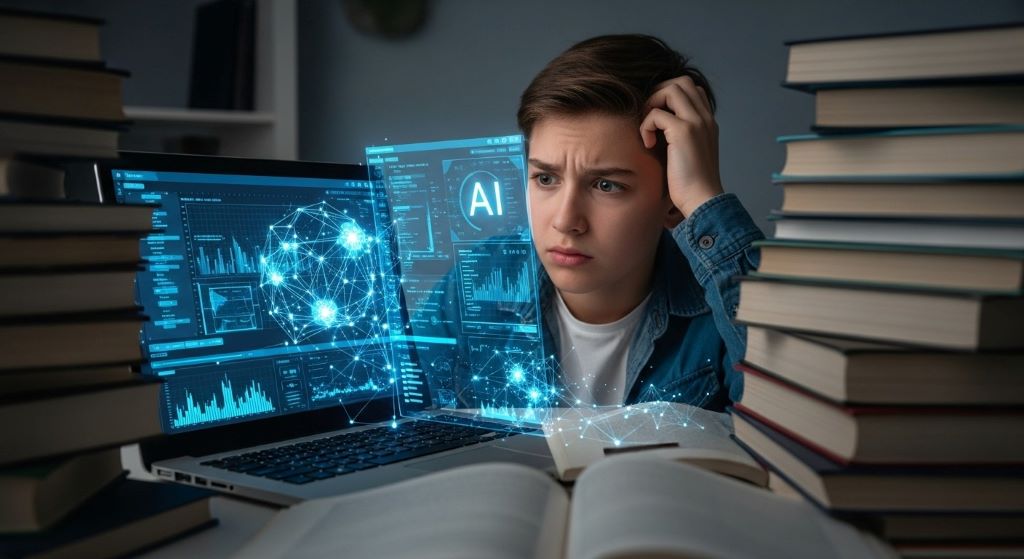
Artificial intelligence is transforming education rapidly. Students now have access to powerful AI tools. These technologies promise personalized learning and instant answers. However, beneath the surface lie significant concerns. Many educators and researchers are raising alarms. At Education Guide Blog, we explore both the benefits and risks of educational technology.
AI tools can generate essays, solve complex problems, and create study guides. They seem incredibly helpful at first glance. Students can get immediate feedback on their work. Additionally, they can access information faster than ever before. Nevertheless, these conveniences come with hidden costs. The impact on learning depth and critical thinking is substantial.
Understanding why is AI bad for education requires examining multiple factors. The technology affects how students process information. It changes their relationship with learning itself. Moreover, it creates dependencies that weaken essential skills. Therefore, a closer look at these drawbacks is necessary.
The Erosion of Critical Thinking Skills
AI tools provide instant answers to complex questions. Students no longer need to struggle through problems. They can simply ask an AI chatbot for solutions. This convenience undermines the learning process fundamentally.
Critical thinking develops through challenge and effort. When students grapple with difficult concepts, their brains form new connections. They learn to analyze, evaluate, and synthesize information. However, AI shortcuts this process entirely. The technology does the thinking for them.
Research shows that struggle is essential for deep learning. The brain strengthens through cognitive effort. When students outsource this work to AI, they miss crucial development opportunities. Their analytical skills remain underdeveloped. Consequently, they become less capable of independent thought.
Furthermore, AI-generated answers often lack nuance. They provide surface-level responses to complex questions. Students who rely on these answers develop shallow understanding. They cannot engage deeply with subject matter. This creates a generation of learners who know facts but cannot think critically about them.
Weakening of Research and Information Literacy
Traditional research teaches valuable skills. Students learn to evaluate sources. They distinguish between reliable and unreliable information. Additionally, they develop the ability to synthesize multiple perspectives. AI tools disrupt this learning process significantly.
When AI summarizes information, students skip the evaluation step. They trust the technology without question. However, AI systems can produce inaccurate or biased information. Students who do not verify these outputs become vulnerable to misinformation.
Information literacy involves more than finding answers. It requires understanding context and recognizing bias. Students must learn to trace information to original sources. They need to assess credibility and relevance. These skills atrophy when AI does the work automatically.
Moreover, AI-generated summaries remove students from primary sources. They no longer engage with original texts and research. This distance creates intellectual gaps. Students miss the depth and complexity of actual scholarship. Therefore, their understanding remains superficial and incomplete.
Dependence and Loss of Self-Reliance
AI tools create powerful dependencies. Students begin relying on technology for basic tasks. They struggle to function without algorithmic assistance. This dependence has serious long-term consequences.
Self-reliance builds through practice and repetition. Students need to solve problems independently. They must learn to trust their own thinking. However, AI tools undermine this confidence. Students doubt their abilities without technological support.
The phenomenon affects even simple academic tasks. Students use AI to outline essays, check grammar, and generate ideas. They cannot complete assignments without these crutches. Consequently, their self-efficacy decreases over time. They become passive consumers rather than active learners.
Additionally, this dependence creates practical problems. During exams without AI access, students struggle significantly. They have not developed the skills to work independently. Their performance drops dramatically. This gap reveals how little authentic learning has occurred.
Diminished Memory and Retention
Memory formation requires active engagement with material. Students must process, organize, and recall information repeatedly. This process strengthens neural pathways. However, AI tools interfere with these essential mechanisms.
When students use AI to summarize textbooks, they skip active reading. Their brains do not process the material deeply. Similarly, AI-generated study guides prevent students from creating their own organizational frameworks. These shortcuts result in poor memory retention.
Research demonstrates that retrieval practice strengthens memory. Students need to actively recall information without aids. This effort consolidates learning. However, constant AI access eliminates retrieval practice. Students can always look up answers instantly. Therefore, they never develop strong memory skills.
Furthermore, AI tools encourage passive consumption of information. Students read AI summaries instead of engaging with source material. This passive approach produces weak memories. Information does not stick because it was never truly processed. The result is surface-level knowledge that disappears quickly.

Reduction in Writing and Communication Skills
Writing is a thinking tool. The process of composing helps clarify thoughts. It teaches students to organize ideas logically. Additionally, writing develops communication skills essential for success. AI tools threaten these developmental processes.
When AI generates essays, students miss the learning process. They do not struggle to find the right words. They skip the revision and refinement stages. Consequently, their writing abilities stagnate. According to The New York Times, educators are increasingly concerned about AI’s impact on student writing skills.
Writing teaches more than grammar and structure. It develops voice and style. Students learn to express unique perspectives. They discover their intellectual identity through writing. However, AI-generated content lacks personal voice. Students who rely on it never develop their own writing style.
Moreover, the editing process teaches critical evaluation. Students learn to assess their own work objectively. They identify weaknesses and make improvements. This metacognitive skill transfers to other areas. However, AI tools bypass this valuable learning opportunity entirely.
Academic Dishonesty and Ethical Concerns
AI makes cheating easier than ever before. Students can generate entire assignments in seconds. Detection remains difficult and unreliable. This creates a crisis of academic integrity.
The ease of AI cheating normalizes dishonesty. Students rationalize that everyone does it. The behavior becomes accepted rather than exceptional. This shift in academic culture has lasting consequences. It undermines the value of education itself.
Furthermore, AI use raises questions about authentic assessment. How can educators measure genuine learning? Traditional assignments no longer serve their purpose. This forces a complete rethinking of educational evaluation. However, many institutions are not prepared for this challenge.
Ethical boundaries remain unclear to many students. They do not understand where assistance ends and cheating begins. AI tools blur traditional lines. Students genuinely believe they are just using available resources. This confusion creates ethical gray areas throughout education.
Loss of Creative Thinking and Original Ideas
Creativity flourishes through exploration and experimentation. Students need space to develop unique ideas. They must learn to think divergently and take intellectual risks. However, AI tools standardize thinking and reduce creativity.
When AI suggests ideas, students follow algorithmic patterns. They produce work that resembles countless other AI-generated outputs. Original thinking diminishes. Students become imitators rather than innovators. This has profound implications for future innovation.
Creative breakthroughs often come from unexpected connections. Human minds make intuitive leaps that algorithms cannot. Students need to develop this capacity through practice. However, AI dependence prevents creative muscle development. The result is a generation of conformist thinkers.
Additionally, AI-generated content tends toward mediocrity. It produces average, safe responses. Students who rely on it never push boundaries. They settle for acceptable rather than exceptional work. This limits their potential and reduces overall intellectual quality.
Widening Educational Inequality
AI access creates new divides among students. Those with advanced AI tools gain significant advantages. Meanwhile, students without access fall further behind. This digital divide exacerbates existing educational inequalities.
Wealthy students access premium AI services with advanced capabilities. They receive better outputs and more sophisticated assistance. Poor students cannot afford these tools. Therefore, the achievement gap widens. Technology that promised democratization instead increases stratification.
Furthermore, AI literacy itself becomes a class marker. Students from privileged backgrounds learn to use AI effectively. They understand its capabilities and limitations. However, disadvantaged students lack this knowledge. They use AI ineffectively or inappropriately. This knowledge gap creates additional barriers.
Teachers in underfunded schools often lack resources to address AI challenges. They cannot teach appropriate use or provide alternatives. Consequently, their students suffer disproportionately. The technology deepens educational inequity rather than solving it.
Impact on Teacher-Student Relationships
Education thrives on meaningful relationships between teachers and students. These connections foster motivation and engagement. However, AI tools disrupt these essential bonds significantly.
When students rely on AI, they seek less help from teachers. They no longer engage in valuable one-on-one discussions. Teachers lose opportunities to understand student thinking. This distance weakens the teaching relationship fundamentally.
Moreover, AI creates trust issues between educators and learners. Teachers must constantly question work authenticity. They become suspicious rather than supportive. This adversarial dynamic damages the learning environment. Students feel mistrusted even when being honest.
Additionally, AI reduces meaningful feedback opportunities. Teachers spend time detecting AI use instead of providing substantive guidance. Their expertise becomes underutilized. The valuable mentorship aspect of education diminishes. Both parties lose from this shift in relationship dynamics.
Preparation Gap for Real-World Challenges
Education should prepare students for life beyond school. They need problem-solving abilities that transfer to various contexts. However, AI dependence creates graduates unprepared for real challenges.
Most workplaces expect independent thinking and creativity. Employers want employees who can analyze complex situations. They need workers capable of original solutions. However, AI-dependent students lack these capabilities. They struggle when algorithmic support disappears.
Furthermore, professional success requires resilience and persistence. Workers must tackle difficult problems without giving up. These qualities develop through academic struggle. However, AI tools prevent students from building such resilience. They have never learned to persevere through challenges.
The gap becomes apparent in job performance and career advancement. AI-reliant graduates cannot compete with those who developed authentic skills. They face unemployment or underemployment. According to The Washington Post, employers are noticing declining critical thinking skills among recent graduates. This creates a workforce crisis affecting economic productivity.
Finding Balance in AI-Enhanced Education
Recognizing AI’s drawbacks does not mean rejecting technology entirely. Instead, educators must implement thoughtful guidelines. Students need to understand appropriate AI use. They should leverage technology without becoming dependent.
Effective integration requires clear boundaries. Some tasks should remain AI-free zones. Students must develop core skills through traditional methods. Only then can they use AI as a supplementary tool. This balanced approach preserves essential learning.
Teachers play a crucial role in this balance. They must model appropriate technology use. Additionally, they should create assignments that require authentic human thinking. Such tasks resist AI shortcuts. They force students to engage deeply with material.
Parents also bear responsibility for monitoring AI use. They should discuss ethical implications with children. Furthermore, they can encourage technology-free study time. This helps students build confidence in their own abilities.
Conclusion
AI-assisted studying presents significant unseen drawbacks. These technologies erode critical thinking and research skills. They create dependencies that weaken self-reliance. Additionally, AI tools diminish memory retention and writing abilities. Academic dishonesty becomes easier and more common. Creative thinking suffers as students produce standardized outputs.
Furthermore, AI widens educational inequality and damages teacher-student relationships. Students emerge unprepared for real-world challenges. The long-term consequences affect individual success and societal progress. Therefore, educational institutions must address these issues urgently.
Recognizing these drawbacks is the first step toward solutions. Educators need strategies that preserve authentic learning while acknowledging technological realities. Students require guidance on appropriate AI use. Parents must engage in conversations about technology and education. Together, these stakeholders can navigate AI’s challenges while protecting educational quality.
The future of education depends on thoughtful technology integration. We cannot ignore AI’s presence. However, we must not allow convenience to replace genuine learning. By understanding and addressing these drawbacks, we can create educational experiences that truly prepare students for meaningful lives.
Frequently Asked Questions
Does AI always harm student learning?
No, AI does not always harm learning. The impact depends on how students use the technology. When used appropriately as a supplementary tool, AI can enhance certain aspects of education. However, over-reliance and inappropriate use create the problems discussed in this article. Students need guidance to use AI responsibly without sacrificing essential skill development.
Can teachers effectively detect AI-generated student work?
Detection remains challenging and imperfect. While specialized software exists, it produces false positives and misses sophisticated AI use. Moreover, students constantly find ways to make AI output less detectable. Teachers often rely on knowing their students and noticing sudden quality changes. However, this method is unreliable and time-consuming.
How can students develop critical thinking despite AI availability?
Students can develop critical thinking through deliberate practice. They should tackle challenging problems without AI assistance. Additionally, engaging in debates, analyzing primary sources, and solving open-ended problems helps. Teachers can design assignments that require original thought and cannot be easily completed with AI. Self-discipline and awareness of AI’s limitations are also important.
Will future jobs require AI skills or traditional skills?
Future jobs will likely require both AI literacy and strong traditional skills. Knowing how to use AI tools will be valuable. However, critical thinking, creativity, and problem-solving remain irreplaceable. Employers will seek workers who can think independently and innovate. The most successful professionals will combine technological competence with authentic human capabilities.
What should parents do about their children using AI for homework?
Parents should have open conversations about AI use. They should establish clear boundaries for appropriate technology use. Monitoring study habits and encouraging AI-free practice time helps. Additionally, parents can emphasize the importance of genuine learning over grades. Supporting their children in developing authentic skills prepares them better for future success.
Related Topics:
Unlocking Your Academic Potential: The College Student’s Guide to Motivated Studying
What Are the Three Key Concepts in Transformational Learning?