
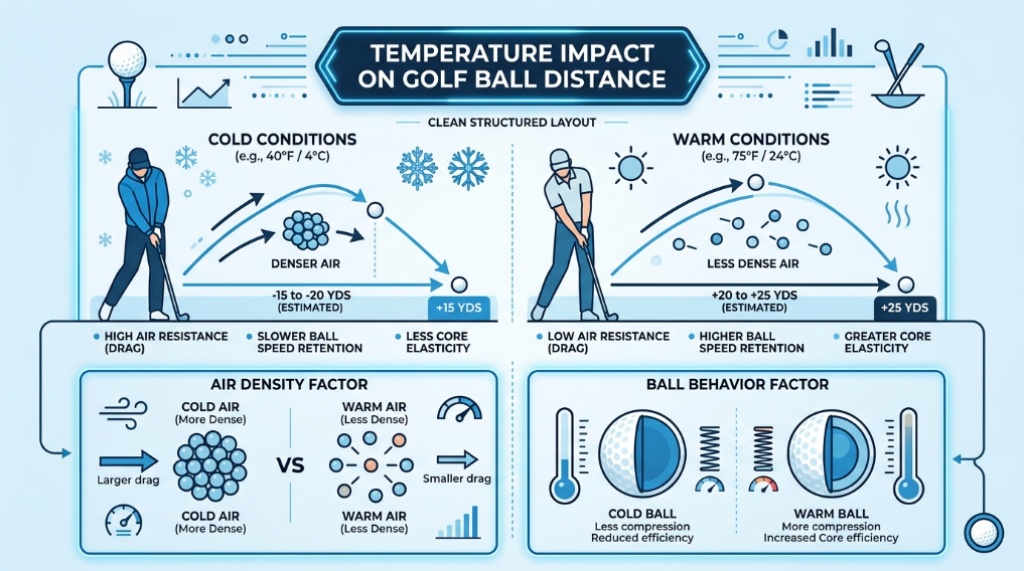
You step onto the first tee on a crisp 45-degree morning, strike what feels like a solid drive, and watch the ball land 15 yards short of where it would have landed in July. The swing felt fine. The contact was clean. So what happened? Cold air changes nearly everything about how a golf ball behaves, from how far it flies to how it feels off the clubface. If you are working through a guide to buying TaylorMade distance golf balls for colder conditions, understanding how temperature affects performance will help you choose a ball that actually fits the way you play in fall, winter, and early spring.
Quick Answer
Cold weather reduces golf ball distance primarily because lower air temperatures make the ball harder and less elastic, which lowers ball speed and increases spin. A temperature drop of roughly 20 degrees Fahrenheit can cost the average golfer about 5 to 10 yards on a driver, and the effect compounds on irons and wedges. Cold air is also denser, which adds aerodynamic drag. Soft, low-compression golf balls and a few simple adjustments can recover much of that lost distance.
Key Takeaways
- Cold temperatures make the golf ball firmer, reducing the energy it returns at impact and cutting ball speed.
- Denser cold air increases drag, so even a perfectly struck shot loses distance.
- Lower-compression balls generally handle cold weather better than high-compression tour balls.
- You can offset some distance loss by clubbing up, keeping balls warm, and adjusting for reduced carry and roll.
- Cold-weather performance loss cannot be eliminated entirely, only managed through equipment and strategy.
Why Cold Air Steals Distance From Your Golf Ball
Golf balls are engineered to deform at impact and then snap back, transferring energy into forward speed. That elasticity depends heavily on temperature. When the ball gets colder, the rubber and core materials become firmer, so the ball compresses less and returns less energy. The result is a slower ball off the face, even when your swing speed stays the same.
At the same time, colder air is denser than warm air. Denser air creates more aerodynamic drag on the ball during flight, which shortens both carry and total distance. So two effects stack on top of each other: less energy going into the ball, and more resistance pulling it back.
Temperature and Compression Explained
Every golf ball has a compression rating, which describes how much it deforms under force. Lower compression means the ball is softer and easier to compress. Higher compression means the ball is firmer and generally requires more swing speed to fully activate.
In warm weather, a high-compression ball can deliver excellent speed and low spin for fast swingers. In cold weather, that same ball may feel like a rock and underperform, because the golfer cannot compress it enough to unlock its design. A softer, lower-compression ball often asks less of the player in cold conditions and can produce better results for many golfers.
How Much Distance Do You Actually Lose?

Most golfers lose a meaningful amount of distance, but the exact number depends on temperature, swing speed, ball type, and shot trajectory. As a general pattern, a drop of about 20 degrees Fahrenheit tends to cost roughly 5 to 10 yards on a driver for the average recreational golfer. Irons and wedges are affected too, usually in a smaller but still noticeable range.
Another way to think about it: each 10-degree drop in temperature is often associated with a small loss in carry, and the effect grows progressively as you move from mild to freezing conditions. Extremely cold rounds can shave off double-digit yardage per club compared with a warm summer day.
Look at Carry and Roll Separately
Cold weather reduces carry distance because of loss of ball speed and increased drag. It also reduces roll, because colder, softer fairways and firmer greens absorb more energy when the ball lands. On many winter courses, the ground is damp and soft, so the ball plugs or checks up rather than rolling out. That means your total distance loss is usually larger than your carry loss alone.
Understanding this distinction matters for club selection. If you only account for reduced carry, you may still come up short because the ball is not releasing the way it does in summer. Club up for the combined effect, not just the airborne portion.
Does Ball Type Really Matter in Cold Weather?
Yes, ball type matters significantly in cold weather, though the effect is often smaller than the golfer’s swing itself. Soft, low-compression golf balls tend to hold up better in cooler temperatures because they are easier to compress. Distance-oriented designs usually prioritize lower spin and softer covers to help everyday players get more carry, which can be an advantage when the air is less cooperative.
That does not mean a distance ball automatically becomes a cold-weather ball. Some distance balls are still fairly firm, and some softer tour-style balls can perform well in cold weather because their cores stay more responsive. The key is matching the ball to your swing speed and the conditions you actually play in, not just to the label on the box.
A Simple Cold-Weather Ball Checklist
- Choose a lower-compression ball if your swing speed is moderate, since it compresses more easily in cold air.
- Prioritize low spin off the driver if you struggle with distance loss during cold rounds.
- Do not assume a premium tour ball is always best; it may underperform if you cannot fully load it.
- Keep a few balls rotating in your pocket so you are always hitting a warmer ball.
- Test a ball across a few rounds rather than judging it from a single cold shot.
How Cold Weather Changes Spin, Feel, and Trajectory
Cold weather increases spin for many golfers relative to how the same swing performs in warm conditions. The ball tends to slide up the face a little more, and the firmer feel can make it harder to control trajectory. Higher spin combined with denser air often produces a shorter, higher, ballooning ball flight, especially on a poor strike.
Feel is the most immediate difference. A high-compression ball in cold weather feels hard and clicky, and off-center strikes vibrate more. Softer balls feel less punishing, though some golfers prefer the feedback they get from a firmer ball. Whatever you choose, expect the acoustics and sensation to change with the thermometer.
Trajectory Adjustments Worth Making
You may find that trying to hit a lower, more penetrating trajectory helps in cold conditions, because a lower flight spends less time fighting drag. A simple approach is to take one more club with a smoother, more controlled swing, letting the club’s loft do the work instead of forcing extra effort. This often produces a more predictable result than swinging harder.
Practical Ways to Reduce Cold-Weather Distance Loss
You cannot beat physics entirely, but you can limit the damage. The most effective adjustments combine equipment choices with smarter on-course decisions.
- Switch to a lower-compression ball when temperatures drop, especially if your swing speed is modest.
- Keep golf balls warm before you play and rotate them during the round.
- Club up by one to two clubs to offset the loss of carry and roll.
- Warm up thoroughly, since cold muscles reduce swing speed and make solid contact harder.
- Aim for more controlled, smooth swings rather than maximum effort.
- Account for reduced roll on soft fairways by playing to a longer target than usual.
You should also walk when possible. Walking keeps your body warmer and your muscles more responsive than riding in a cart, which can help preserve swing speed across the round.
Common Mistakes Golfers Make in Cold Weather
- Swinging harder to make up distance: This usually increases spin and mishits, making the problem worse.
- Ignoring the roll reduction: Only compensating for carry leaves approach shots short.
- Using the same firm tour ball year-round: A ball that suits summer may not suit December.
- Skipping the warm-up: Cold muscles cost speed and consistency before you ever hit a shot.
- Leaving balls in the car overnight: A cold ball stays stiff well into the round.
- Judging a new ball by one bad cold-weather shot: Cold conditions distort a fair assessment.
Frequently Asked Questions
How much distance do you lose per 10 degrees of temperature?
As a general guide, many golfers see roughly 1 to 2 yards of driver carry loss per 10 degrees Fahrenheit of temperature drop, though the exact amount varies by swing speed, ball type, and conditions. The loss tends to accelerate in genuinely cold weather.
Do low-compression golf balls really fly farther in cold weather?
Often yes for moderate swing speeds, because they compress more easily and can restore some ball speed. Very fast swingers may not notice much difference, and results always depend on the specific design and the player.
Should I change golf balls for winter golf?
It is worth considering. A softer ball that still offers low spin can help you keep more distance and feel less vibration. Test a couple of options in real cold-weather rounds before committing.
Does cold weather affect putting too?
Yes. A cold ball comes off the putter face more slowly, and some players find distance control harder on slow, cold greens. The effect is smaller than with driver and irons but still noticeable.
Can I stop losing distance in cold weather entirely?
No. Cold air and a firmer ball impose real physical limits. You can reduce the loss through ball choice, clubbing up, warm-up routine, and smart strategy, but you cannot eliminate it.
Conclusion
Cold weather reduces golf ball distance because the ball becomes firmer, the core returns less energy, and denser air adds drag. The result is less carry, less roll, and more spin for many golfers. You cannot reverse physics, but you can manage it. Choose a ball that matches your swing speed and the conditions, club up, keep your balls warm, and swing smoothly rather than harder. Do those things and a cold-weather round becomes far more predictable, even if it will never play quite like summer.